Heavily Invested in Cameras and Fencing,
But what about your digital front door? WIDE OPEN?
It is a familiar sight at many commercial properties: intruders are kept at bay with expensive alarm systems, CCTV cameras, and heavy security locks featuring certified, patented reversible keys and advanced master key systems. Nobody just walks in.
Yet at the digital backend, all your data traffic passes through a cheap, unsecured, default provider modem. The physical front door is locked tight with a certified master key system, but the digital front door is wide open.
The myth of "Nothing to hide": Why unencrypted DNS requests mean your provider and third parties see exactly who you do business with, which suppliers you visit, and when your office is unoccupied. Trade secrets and privacy leak away silently.
Switching to Ubiquiti or OPNsense/pfSense might look like a step towards independence at first glance. However, Ubiquiti keeps you tied to an American cloud ecosystem, while OPNsense and pfSense introduce a whole new layer of complexity and human error due to their overwhelming maze of graphical settings. You shift the dependency, but you don't necessarily eliminate it.
It can feel that way, but that is a misconception. There is a huge difference between an advertising profile on social media and your actual business records.
Your quotes, client contracts, bank statements, and business emails are not public property, and you certainly want to keep it that way. Effective security is not about becoming invisible; it is about sound operational reliability:
Think of it like your front door at home: even though everyone knows your street address, you still lock up every night.
"Isn't everything out in the open already? Does securing it still make sense?"
The sovereign Adios Windows answer: a locally managed OpenBSD firewall powered by PF. The entire configuration lives in a single clean text file and can be described almost mathematically: if this, then that; otherwise block. No labyrinth of menus, no cloud mandates, no unnecessary telemetry, and no hidden dependencies.
False Solutions Offering False Security
The Commercial 'Cloud' Router: a slick dashboard suggests you have everything under control. In reality, you depend on the vendor for licenses, updates, and support, while telemetry and the ultimate destination of your metadata remain largely obscured from view.
Many business owners assume they are safe just because their gear looks professional.
Do you genuinely know the risks lurking behind these hardware choices?
• Cisco Meraki / Aruba Instant On:
Slick cloud dashboards, but tied to mandatory annual licenses.
Stop paying? The vendor remotely disables your router. It literally turns into an expensive paperweight. You do not truly own the hardware; you are renting the permission to use your own! network.
• Ubiquiti UniFi / Zyxel Nebula:
Quickly set up via a smartphone app, but the master key to your entire network resides in an American cloud. If the vendor suffers a data breach, your business network is exposed.
• OPNsense / pfSense / MikroTik:
Marketed as 'secure', yet their hundreds of intricate tabs and check boxes make fatal human configuration mistakes remarkably easy to commit.
• DrayTek:
The classic workhorse of small businesses. Sitting in many small offices is a little box installed by a contractor years ago and left untouched ever since.
DrayTek is not a cloud router in the modern sense, but that doesn't mean you're in the clear. The management interface looks and feels dated, and its firmware has repeatedly been hit by severe vulnerabilities over the years. That is precisely where the issue lies: a router is only as secure as the maintenance it receives. A box tucked away in a cabinet for years without structured maintenance sooner or later becomes a liability rather than a defense.
- TP-Link, D-Link, Netgear, and ASUS:
Brands that are recurrent subjects of security audits due to outdated Linux kernels, fragile codebases, and poor security baselines. Hardcoded credentials and unpatched remote management ports are far from theoretical risks. For devices tasked with guarding your entire network perimeter, that is anything but comforting.
These all-in-one standard routers cram every function into a single plastic box: modem, firewall, and Wi-Fi. While seemingly convenient, this means a single compromised device on the wireless network can gain almost direct access to the rest of your infrastructure. A compromised printer, surveillance camera, or visitor laptop should never sit side by side with your workstations, servers, and bookkeeping records.
A quick word on Cisco:
Even enterprise-grade routers can include capabilities never intended to benefit the business owner. For instance, Cisco formally documents Lawful Intercept features across various router platforms, technically facilitating state-sanctioned surveillance via telecom carriers and ISPs. While not a secret backdoor, it remains an added surface area that becomes an enticing target if an unauthorized attacker ever gains elevated access. Why should you introduce such capabilities into your business network when you will never need them and cannot audit the underlying proprietary code?
The firewall might watch the front door dutifully, while an unchecked backdoor inside the local network remains wide open. Effective network design begins right here: not only controlling who enters, but also strictly limiting where anyone can travel once inside.
The Backdoor, Solved
I implement a professional network architecture: the OpenBSD firewall stands guard unyieldingly at the front door, while dedicated, standalone Wi-Fi access points provide fast and reliable wireless coverage.
Crucially, the real protection takes place behind that front door. The network is logically segmented so that guests, IoT devices, and less trusted hardware cannot talk freely to your computers, servers, and administration.
A visitor can safely use the Wi-Fi. A printer can perform its duties. A security camera can reach only its designated recorder. None of these devices ever get automatic lateral access to your core business network.
The backdoor stays locked, too.
You might still think: “I have nothing to hide.”
As a business owner or organisation, you are legally and operationally accountable for all data flowing through your network. European legislation, technological developments, and plain business prudence require you to bolt your digital front door securely:
GDPR (Article 32):
You are legally mandated to implement "appropriate technical and organisational measures" to ensure data security. Running outdated network gear riddled with known vulnerabilities can be judged as culpable negligence in the event of a breach.NIS2 & Digital Duty of Care:
Cybersecurity regulations are enforcing ever-stricter requirements regarding supply chain security, vendor risk, and demonstrable mitigation of vulnerabilities.Artificial Intelligence (AI) & Shadow Data Leaks:
AI is now deeply embedded across everyday software and web services. Sometimes intentionally, often invisibly. An employee might paste a sensitive contract, client list, or source code into a third-party AI platform without any corporate agreement or consent in place.Reputation and Business Continuity:
Following a successful intrusion or data breach originating from a compromised router, all liability, financial losses, and reputational damage fall squarely on your shoulders.
A professionally configured OpenBSD firewall demonstrates that you take network security, corporate confidentiality, and client data protection with the utmost seriousness.
"Why invest in a dedicated gateway when my ISP router was included for free?"
The stock router provided by Movistar, Vodafone, or Digi is engineered for cheap mass deployment. It delivers an internet link, but offers zero proactive protection for your corporate data. Our Secure Gateway is not just another plastic modem; it is a professional digital vault door that pays for itself surprisingly quickly.
📈 The Math: Immediate Productivity Gains
By filtering out ad trackers, telemetry networks, distracting ads, and clickbait directly at the network level before they hit screens, a small team of 5 to 6 staff saves an average of 30 minutes daily in reduced distractions and faster loading times. Over the course of a year, that adds up to over 100 hours of recovered productivity. That alone recoups the €650 hardware investment within a few months in billable work hours.
🛡️ Prevention of Downtime and Ransomware
A single careless click on a phishing link can paralyze an entire office for days. Because the Secure Gateway blocks malicious hostnames directly at the DNS level, malware is stopped dead in its tracks before it can ever phone home to command-and-control servers.
🔒 True Privacy
Thanks to encrypted DNS requests (DNS-over-TLS), your internet provider can no longer log which websites, partners, or services your office accesses. Furthermore, guests and personal devices remain safely isolated from your corporate systems via strictly segregated networks (VLANs).
Shadow Artificial Intelligence
This is what Shadow AI looks like: the unmanaged use of AI tools outside organizational visibility and oversight.
A firewall cannot inspect or judge the exact words an employee types into a prompt. What a firewall can do, however, is define and enforce the perimeter in which that activity happens. A properly architected network dictates which internal machines can communicate with the internet, which hosts are permitted to reach external cloud services, and which portions of your infrastructure remain entirely cut off from the outside world.
An invoicing application, for example, has no valid business reason to access the public web freely. An internal database should never establish outbound connections to external AI services. And equipment intended strictly for internal operations is denied any capability to phone home.
While this doesn't replace organizational policies, it provides a vital first line of defense: mitigating risks structurally at the perimeter rather than relying solely on the flawless behavior of every staff member and application in your office.
The Digital Front Door
Then there is the front door itself. The global internet is subjected to non-stop automated scanning for unpatched vulnerabilities and open management ports. That is why a firewall that is merely turned "on" is never enough. The most secure connection is the one that is fundamentally impossible to initiate: whatever has no business being exposed must never be reachable.
Keep closed what doesn't need to be open. This aligns seamlessly with the core OpenBSD development philosophy: enable only what is strictly necessary. Every extra daemon, open port, and non-essential feature widens your attack surface. By systematically eliminating what you do not need, a system becomes far more secure, resilient, and dependable.
Read more about OpenBSD below.
Harnessing AI Without Gifting Away Your Trade Secrets
And staying fully compliant with GDPR / European privacy regulations!
AI can deliver immense productivity gains to modern businesses. The sensible path forward is not to ban AI entirely, but to decide intentionally which data gets entrusted to which platform.
For business areas where confidentiality and governance are non-negotiable, a locally hosted or dedicated private AI environment is the ideal solution. Models, internal documents, and prompts remain completely within infrastructure that you control, with explicit boundaries around data flows.
You do not have to choose between innovation and privacy. With the right architecture, you can achieve both without compromise.
Want to leverage the power of modern AI without the associated privacy liabilities? I can deploy powerful, local, or dedicated private AI environments ensuring all your prompts and records remain sovereign and private.
DNS: The Security Leak Nobody Talks About
DNS (Domain Name System) functions as the phone book of the internet. Whenever you navigate to a website, the DNS protocol resolves the human-readable domain name (such as bankinter.es) into a machine IP address. DNS is one of the foundational protocols of the early internet—and one of its greatest privacy and security vulnerabilities.
What most business owners don't realize is that this lookup process runs completely unencrypted on standard consumer and ISP routers.
Your ISP Looks Over Your Shoulder
In Spain, internet service providers (such as Movistar, Orange, and Vodafone) are legally required to retain customer connection metadata for up to 12 months. Because your workstations query the provider's default DNS servers, your ISP compiles an exhaustive digital fingerprint of your day-to-day operations and personal life. They see precisely:
Which legal, financial, or corporate advisory services you consult.
How frequently you review competitors' platforms.
What personal, medical, or confidential research your team conducts online.
In short: the postal courier handling your letters is opening and reading every envelope you send.
My OpenBSD router halts this data leakage directly at your network perimeter using DNS-over-TLS (DoT) through a dedicated, local DNS resolver (Unbound).
Unbreakable Encryption:
All DNS queries are wrapped inside an encrypted tunnel routed to independent, privacy-focused servers in Switzerland (such as Quad9) that maintain strict zero-logging policies.Completely Blinding Your ISP:
Your internet provider becomes nothing more than a dumb physical pipe, seeing only an unreadable stream of encrypted noise. They can no longer profile your commercial operations.Built-in Ad and Malware Blackholing:
Operating directly at the OS level, the router automatically blocks known phishing domains, botnets, telemetry trackers, and invasive advertising across all connected devices simultaneously—before they ever reach your computer or mobile screen.
This is how you reclaim your digital sovereignty: utilizing the ISP's physical internet line, while keeping absolute sovereignty over your own company data and privacy.
This embodies what I call:
My infrastructure design follows the proven 'Defense in Depth' model, in which each distinct tier provides a dedicated security safeguard. The router is the cornerstone of this design, ensuring your internal network is fortified against external probes and intrusions.
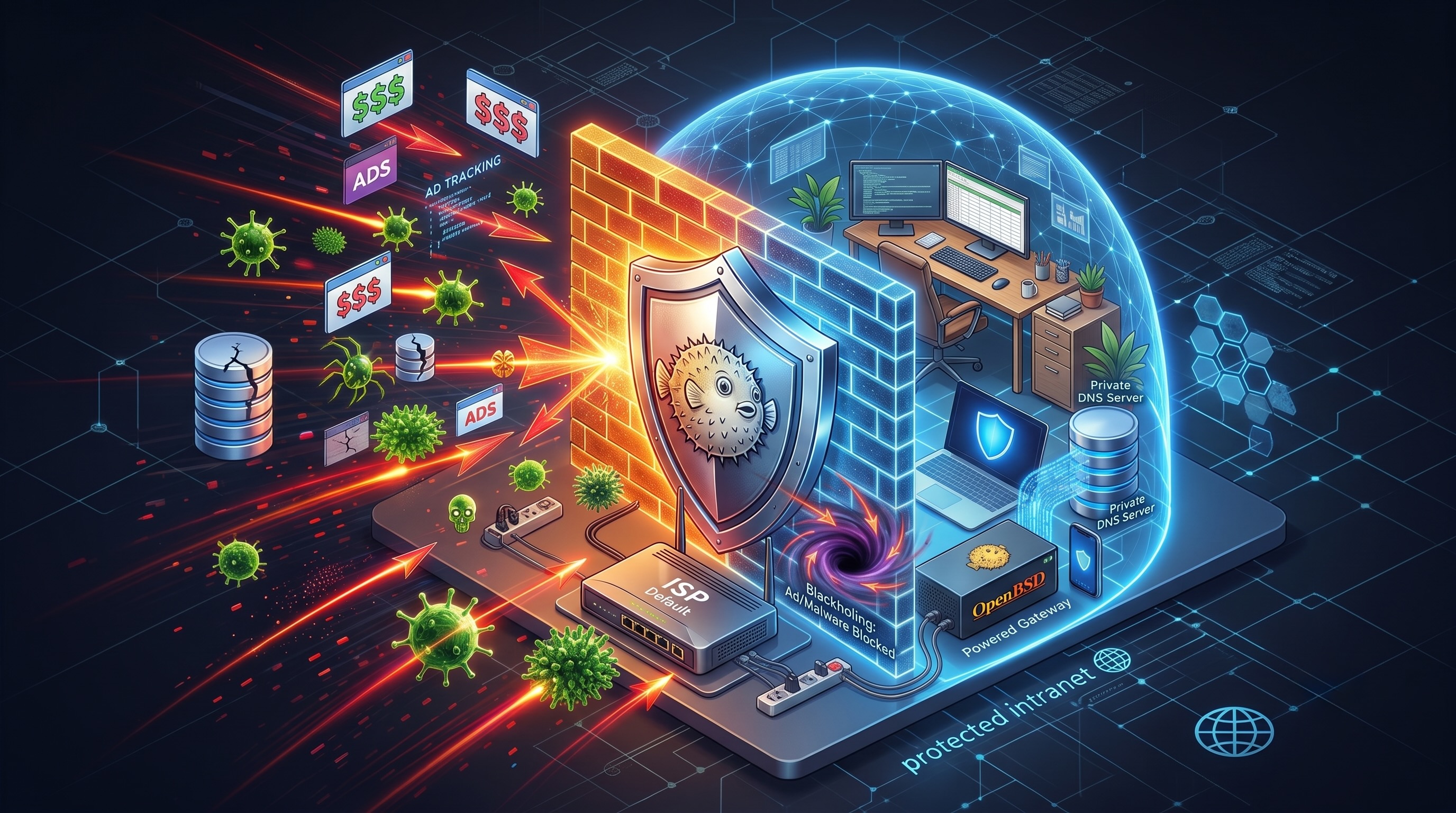
100% In Command of Your Premises: Zero reliance on external vendor cloud controllers.
Battle-Tested Security: Free of Lawful Intercept carrier hooks and bloated software layers.
Turnkey Management: You don't need to learn OpenBSD. I configure the firewall immaculately and ensure your network runs flawlessly without disruption.
What Is OpenBSD Exactly? And Why Is It Rarely in the Headlines?
Almost everyone in tech is familiar with Linux. OpenBSD is far less known to the general public. Yet among veteran system administrators, network engineers, and security specialists, it has commandingly held premier respect for decades.
OpenBSD is an independent operating system engineered from the ground up with an uncompromising focus: security, correctness, and simplicity. No bloated feature creep, no mandatory vendor cloud accounts, and no commercial market pressure to introduce half-baked code. What isn't needed is neither included nor running.
OpenBSD is not immune to bugs, but its philosophy sets it apart: security is not treated as a patch slapped onto an existing system after the fact, but as the governing architectural principle during design and proactive source audits. Code is constantly audited, and unnecessary architectural complexity is ruthlessly eliminated.
This makes OpenBSD uniquely suited for a task where invisibility is a virtue: serving as the digital front door of your business. Configured properly once, it runs silently, predictably, and reliably in the background for years.
The Silent Backbone of the Global Internet
The OpenBSD project has also created some of the most critical security infrastructure running modern computing. The exact same developer culture gave birth to OpenSSH, LibreSSL, OpenNTPD, OpenSMTPD, and PF—technologies relied upon across the globe for encrypted communications, secure shell access, clock synchronization, mail transfer, and enterprise packet filtering.
That track record speaks for itself. OpenBSD may not be a brand splashed across consumer marketing banners, but the software forged by its core team quietly powers the underlying engine of the global internet.
That is why I build with it.
Not because OpenBSD is trendy. Not because it claims to be bulletproof. But because security, transparency, and clarity are not marketing slogans here—they are the core engineering foundation.
And those are the exact attributes required to safeguard the digital front door of your enterprise.